Like And Share With Your Friends

Saturday, 24 January 2015

Tricks and Rules of Average in Details

What is an average?
In simple terms, averages usually refer to the sum of given numbers divided by the total number of terms listed.
Averages = (sum of all terms)/ number of terms

Average is the estimation of the middle number of any series of numbers. 

For example average of 1,2,3,4, 5 is 3.
Average can be calculated by sum of all numbers divided by the total number of numbers
Average of  1,2,3,4,5= (1+2+3+4+5)/5 = 15/5 = 3
Which is also the middle number of the series , from here we can also say that in an A.P. i.e arithmetic progression the middle term is the average of the series .


Rule 1: In the Arithmetic Progression there are two cases when the number of terms is odd and second one is when number of terms is even.
So when the number of terms is odd the average will be the middle term.
And when the number of terms is even then the average will be the average of two middle terms.

Examples 1: what will be the average of 13, 14, 15, 16, 17? 
Solution: Average is the middle term when the number of terms is odd, but before that let’s checks whether it is in A.P or not, since the common difference is same so the series is in A.P.
So the middle term is 15 which is our average of the series.

Let’s check it in another way.
In the first statement of the article we have written that the average of a set of terms is equal to:
Sum of all terms / Number of terms
So the sum of all terms in this case is 75 and the number of terms is 5 so the average is 15.
Now come to the second form when the number of terms are even

Example 2: What will be the average of 13, 14, 15, 16, 17, 18?
Solution: We have discussed that when the number of terms are even then the average will be the average of two middle terms.
Now the two middle terms are 15 and 16, but before that the average we must check that the series should be A.P. Since the common difference is same for each of the term we can say that the series is in A.P.
And the average is (16+15)/2 = 15.5

Rule 2: The average of the series which is in A.P. can be calculated by ½(first + last term)Example 1:  What will be the average of 216, 217 , 218?
Solution: So the answer would be = ½ (216 + 218) = 217
(Which is also the middle term of the series)

Example 2: 
What will be the average of first 10 natural numbers?
Solution: The first 10 natural numbers are 1,2,3,4,5,6,7,8,9,10
So the average will be ½ (1 + 10 ) = ½ (11)  = 5.5

Rule 3: If the average of n numbers is A and if we add x to each term then the new average will be = (A+ x).
For example: The average of 5 numbers is18. If 4 is added to each of the number then the average would be equal to __?
Solution: Old average = 18
New average will be = 4 + old average = 22
This is because each term is increased by 4 so the average would also be increased by 4 so the new average will be 22

Rule 4: If the average of n numbers is A and if we multiply p with each term then the new average will be = (A x p).For Example: The average of 5 numbers is 18. If 4 is multiplied to each of the number then the average would be equal to __? 
Solution: Old average = 18
New average will be = 4 x 18= 72

There are two more operation which can also be applied on the same principle as the above, i.e. subtraction and division.
Rule 5 : In some cases, if a number is included in the series of numbers then the average will change and the value of the newly added term will be = Given average + (number of new terms  x increase in average).
This value will also same as the New average + (number of previous terms  x increase in average ) .

For example: The average age of 12 students is 40. If the age of the teacher also included then the average becomes 44. Then what will be the age of the teacher?
Solution: Average given = 40
Number of students = 12
Therefore the age of the teacher = 40 + (12 + 1) x 4 = 40 + 52 = 92
And this is also calculated as 44 + (12 x 4)= 92
Therefore the average age of the teacher is 92 yrs

Alternatively 
The average of 12 = 40 that means the total number of units are 12 x 40 = 480
Now the new average is 44 and the number of terms are 13 so therefore the total number of units are = 44 x 13 = 572
So the included units would be equal to 572 – 480 = 92

Rule 6:  In some cases  a number is excluded and one more number is added in the series of the number then the average will change by q and the value of the newly added term will be = Replaced Term + (increased in average x number of terms ).

For example: The average age of 6 students is increased by 2years when one student whose age was 13 years replaced by a new boy then find the age of the new boy
Solution: The age of the boy will be = Age of the replaced boy +increase in average x number of terms
i.e. the age of the newly added boy = 13 + 2 x 6 = 25

Rule 7: There are two more cases when the series is divided into two parts and one of the terms is either included or excluded, then the middle term can be calculated by following methods.
Case 1 : When the term is excluded.
Average(total ) + number of terms in first part x {average (total) – average (first part)} + number of terms in second part x {average (total) – average (second part)}

Case 2: When the term is included.
Average (total) + number of terms in first part x {average (first part) – average(total) }+ x number of terms in second part x {average (second part) – average (total)}

For Example: The average of 20 numbers is 12 .The averages of the first 12 is 11 and the average of next 7 numbers is 10. The last number will be?
Solution:
Here in this case one number is excluded so the number would be =
Average(total ) + number of terms in first part x {average (total) – average (first part)} + number of terms in second part x {average (total) – average (second part)}
i.e. =  12 + 12 x (12-11)+(12-10) x 7 = 38.
Read more ...

Thursday, 22 January 2015

Questions and Answers on Partnerships with explanation

When two or more than two persons run a business jointly, they are called partners and the deal is known as partnership.
Ratio of Division of Gains :
(i) When investments of all the partners are for the same time, the gain or loss is distributed among the partners in the ratio of their investments.
Suppose A and B invest Rs. x and Rs. y respectively for a year in a business, then at the end of the year: (A’s share of profit) : (B’s share of profit) = x : y.


(ii) When investments are for different time periods, then equivalent capitals are calculated for a unit of time by taking (capital number of units of time). Now, gain or loss is divided in the ratio of these capitals.
 Suppose A invests Rs. x for ‘p’ months and B invests Rs. y for ‘q’ months, then (A’s share of profit) : (B’s share of profit) = xp : yq.


(III) When investments are altered in the given period we need to take the changes into consideration while calculating their profits.
Suppose A and B started their business with Rs.5000 and Rs.10,000 respectively. If after three months A invested another Rs.5000 then we have to consider A's capital for the remaining period is Rs.10, 000
So A: B = (5000 X 3 + 10,000 X 9) : 10,000 X 12 = 1,05,000 : 1,20,000 = 7:8


3. Working and Sleeping Partners: A partner who manages the business is known as a working partner and the one who simply invests the money is a sleeping partner.


Questions and Solutions on above rules:

1.    A, B, C enter into a partnership investing Rs. 35,000, Rs.45,000 and Rs.55,000 respectively. The respective shares of A, B, C in an annual profit of Rs.40,500 are

Solution : A : B : C = 35000 : 45000 : 55000 = 7 : 9 : 11.

A’s share = Rs (40500 x 7/27) = Rs. 10500

B’s share = Rs.(40500× 9/27) = Rs. 13500

C’s share = Rs.(40500×11/27)= Rs. 16500

2.    In a business, Lucky invests Rs. 35,000 for 8 months and manju invests Rs 42,000 for 10 months. Out of a profit of Rs. 31,570. Manju’s share is :
Solution : ky: Manju = (35000 X 8) : (42,000 X 10) = 2:3
Manju’s share = Rs.3/5×31570 = Rs. 18,942

3.    Amar started a business investing Rs. 70,000. Ramki joined him after six months with an amount of Rs. 1,05,000 and Sagar joined them with Rs. 1.4 lakhs after another six months. The amount of profit earned should be distributed in what ratio among Aman, Rakhi and Sagar respectively, 3 years after Aman started the business ?
Solution: Amar : Ramki : Sagar = (70000 X 36) : (105000 X 30) : (140000 X24) = 12 : 15 : 16.

4.    A, B and C enter into a partnership. They invest Rs. 40,000, Rs. 80,000 and Rs. 1,20,000 respectively. At the end of the first year, B withdrawns Rs. 40,000, while at the end of the second year, C withdraws Rs. 80,000. In what ratio will the profit be shared at the end of 3 years ?
Solution: A : B : C = (40,000 X 36) : (80,000 X 12 + 40,000 X 24) : (120,000 X 24 + 40,000 X 12) = 3: 4: 16

5.    Shekhar started a business investing Rs. 25,000 in 1999. In 2000, he invested an additional amount of Rs. 10,000 and Rajeev joined him with an amount of Rs. 35,000. In 2001, Shekhar invested another additional amount of Rs. 10,000 and Jatin joined them with an amount of Rs. 35,000. What will be Rajeev’s share in the profit of Rs. 1,50,000 earned at the end of 3 years from the start of the business in 1999?.
Solution : Shekhar : Rajeev : Jatin  = (25000 X 12 + 35000 X 12 + 45000 X 12) : (35000 X 24) : (35000 X 12)
= 1260000 : 840000 : 420000 = 3 : 2 : 1.
 Rajeev’s share = Rs.(150000×26)  = Rs. 50000

6.    A,B and C started a business with Rs.15000, Rs.25000 and Rs.35000 respectively.  A was paid 10% of the total profit as a salary and the balance was divided in the ration of investment.  If A’s share is Rs.4,200, then C’s share is: 
Solution : A, B and C must divide their salaries in the ratio : 15,000 : 25,000: 35,000 = 3:5:7
Assume total Profit = 100X.  then A share is 10% of 100X for managing business and 3/15 part of 90X for his investment (as the remaining profit is (100X - 10X = 90X)
So total A's share = 10X+315×90X=4,200
⇒X=150
Substituting X = 150 in 90X we get remaining profit for sharing. That is Rs.13,500
Now C's share = 715×13,500=Rs.6,300
Read more ...

Tuesday, 20 January 2015

Quant Quiz on Percentage


1.    Two students appeared at an examination. One of them secured 9 marks more than the other and his marks was 56% of the sum of their marks. The marks obtained by them are

(a) 36, 46

(b) 42, 33

(c) 24, 64

(d) None of these

2.    A fruit seller had some apples. He sells 40% apples and still has 420 apples. Originally, he had:

(a) 600 Apples

(b) 700 Apples

(c) 500 Apples

(d) None of these 


3.    What percentage of numbers from 1 to 70 has 1 or 9 in the unit's digit?

(a) 20

(b) 22

(c) 21

(d) None of these


4.    If A = x% of y and B = y% of x, then which of the following is true?

(a) A is smaller than B.

(b) A is greater than B

(c) Relationship between A and B cannot be determined.

(d) None of these


5.    In a certain school, 20% of students are below 8 years of age. The number of students above 8 years of age is 2/3 of the number of students of 8 years of age which is 48. What is the total number of students in the school?

(a)50

(b)100

(c)80

(d)72


6.    A student multiplied a number by 3/5 instead of 5/3. What is the percentage error in the calculation?

(a)34%

(b)44%

(c)54%

(d)64%


7.    In an election between two candidates, one got 55% of the total valid votes, 20% of the votes were invalid. If the total number of votes was 7500, the number of valid votes that the other candidate got, was:

(a) 3000

(b)2700

(c)2900

(d) 3500


8.    Three candidates contested an election and received 1136, 7636 and 11628 votes respectively. What percentage of the total votes did the winning candidate get?

(a) 57%

(b)60%

(c)65%

(d) 90%


9.    Helen went to the stationers and bought things worth Euro 25, out of which 30 paise went on sales tax on taxable purchases. If the tax rate was 6%, then what was the cost of the tax free items?

(a) Euro 15

(b) Euro 15.7

(c) Euro 19.7

(d) Euro 20


10.  The population of a town increased from 1,75,000 to 2,62,500 in a decade. The average percent increase of population per year is:

(a) 4.37%

(b) 5%

(c) 6%

(d) 8.75%


Answer With Explanation

1.    (b)
Explanation: Let their marks be (x + 9) and x.
Then, x + 9 = 56/100(x + 9 + x)
25(x + 9) = 14(2x + 9)
3x = 99
x = 33
So, their marks are 42 and 33.

2.    (b)
Explanation: Suppose originally he had x apples.
Then, (100 - 40)% of x = 420.
60/100 x x = 420
x = (420 x 100)/60 = 700

3.    (a)
Explanation: Clearly, the numbers which have 1 or 9 in the unit's digit, have squares that end in the digit 1.
Such numbers from 1 to 70 are 1, 9, 11, 19, 21, 29, 31, 39, 41, 49, 51, 59, 61, 69.
Number of such number =14
Required percentage = (14/70 x 100)% = 20%. 

4.    (d)
Explanation: x% of y = (x/100 x y) = (y/100 x x) = y% of x
A = B. 

5.    (b)
Explanation: Let the number of students be x.
Then, Number of students above 8 years of age = (100 - 20)% of x = 80% of x.
80% of x = 48 + 2/3 of 48
80/100x = 80
x = 100. 

6.    (d) 

7.    (b)
Explanation: Number of valid votes = 80% of 7500 = 6000.
Valid votes polled by other candidate = 45% of 6000
= (45/100 x 6000) = 2700. 

8.    (a)
Explanation: Total number of votes polled = (1136 + 7636 + 11628) = 20400.
Required percentage = (11628/20400 x 100)% = 57%. 

9.    (c)
Explanation: Let the amount taxable purchases be Euro x.
Then, 6% of x = 30/100
x = (30/100 x 100/6) = 5.
Cost of tax free items = Euro [25 - (5 + 0.30)] = Euro 19.70 

10.  (b)
Explanation: Increase in 10 years = (262500 - 175000) = 87500.
Increase% = (87500/175000 x 100)% = 50%.
Required average = (50/10)% = 5%.

Read more ...

Tuesday, 13 January 2015

Quantitative Aptitude Quiz

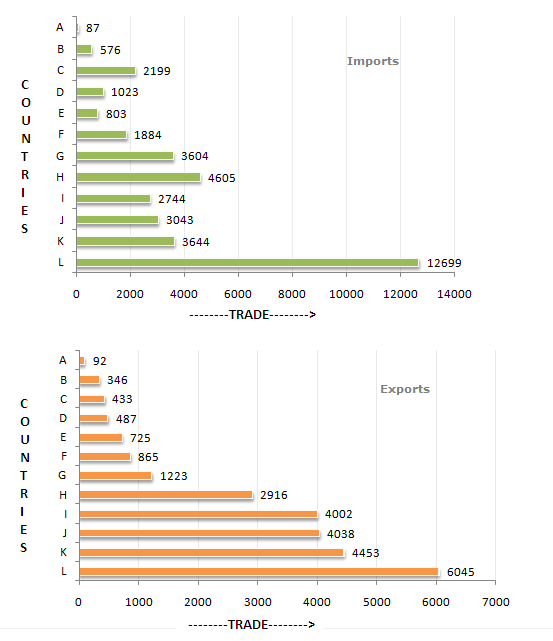
(Directions: 1-5): Study the following bar charts carefully and answer the questions asked below.

Foreign Trade (Imports and Exports) by various countries


1. The ratio of the maximum exports to the minimum imports was closest to ?
(a) 64
(b) 69
(c) 74
(d) 79

2. How many countries exhibited a trade surplus ?

(a) 5
(b) 3
(c) 4
(d) 6

3. The total trade deficit/surplus for all the countries (together) was ?

(a) 11286 surplus
(b) 11286 deficit
(c) 10286 deficit
(d) 10286 surplus

4. The highest trade deficit was shown by which country ?

(a) C
(b) G
(c) H
(d) L

5. The ratio of exports to imports was highest for which country ?

(a) I
(b) A
(c) J
(d) K

6. If the sum of two numbers is 55 and the HCF and LCM of these numbers are 5 and 120 respectively, then the sum of the reciprocals of the numbers is equal to:

(a) 55/601
(b) 601/55
(c) 11/120
(d) 120/11

7. A family consists of two grandparents, two parents and three grandchildren. The average age of the grandparents is 67 years, that of the parents is 35 years and that of the grandchildren is 6 years. What is the average age of the family?
(a) 28 4/7 years
(b) 31 5/7 years
(c) 32 1/7 years
(d) None of these

8. 50 men took a dip in a water tank 40 m long and 20 m broad on a religious day. If the average displacement of water by a man is 4 cubic metre, then the rise in the water level in the tank will be:
(a) 20 cm
(b) 25 cm
(c) 35 cm
(d) 50 cm

9. A, B and C jointly thought of engaging themselves in a business venture. It was agreed that A would invest Rs.6500 for 6 months, B, Rs.8400 for 5 months and C, Rs.10,000 for 3 months. A wants to be the working member for which, he was to receive 5% of the profits. The profit earned was Rs.7400. Calculate the share of B in the profit.
(a) Rs.1900
(b) Rs.2660
(c) Rs.2800
(d) Rs.2840

10. 8 litres are drawn from a cask full of wine and is then filled with water. This operation is performed three more times. The ratio of the quantity of wine now left in cask to that of water is 16 : 65. How much wine did the cask hold originally?
(a) 18 litres
(b) 24 litres
(c) 32 litres
(d) 42 litres

ANSWERS:

1. (b)
The value of maximum exports = 6045.
The value of minimum imports = 87.
Therefore, the required ratio (6045/8)= 69.48 = 69 (approximately).

2. (c)
Out of a total of 12 countries, 8 showed a deficit while 4 showed a surplus.

3. (b)
Exports= 25625
Imports= 36911
Sum of exports - Sum of imports = deficit (11286).

4. (d)
Visually its clear that L has the highest trade deficit.

5. (a)
I has a ratio of 4002/2744 = 1.45, which is the highest.

6. (c)
Let the numbers be a and b.
Then, a+b= 55 and ab= 5*120= 600.
So the required sum= (1/a)+ (1/b)= (a+b)/ab=55/600= 11/120

7. (b)
Required average= (67*2+35*2+6*3)/(2+2+3)
= (134+70+18)/(7)
= 222/7
= 31 5/7 years

8. (b)
Total volume of water displaced= (4*50) cubic metre= 200 cubic metre
Rise in water level = (200/40*20)m= 0.25m= 25cm.

9. (b)
For managing, A received = 5% of Rs.7400= Rs.370
Balance= Rs.(7400-370)= Rs.7030
Ratio of their investments= (6500*6):(8400*5):(10000*3)= 39000:42000:30000
= 13:14:10
So, B's share= Rs.[7030*(14/37)] = Rs.2660

10. (b)
Let the quantity of the wine in the cask originally be x litres.
Then, quantity of wine left in cask after 4 operations= [x{1-(8/x)^4}] litres
So, [x{1-(8/x)}^4]/x= 16/81
= [1-(8/x)]^4=(2/3)^4
= (x-8)/x=2/3
= 3x-24= 2x

= x=24
Read more ...

Saturday, 10 January 2015

Quant Quiz For SSC Exam

Dear reader here we are providing some question on quant aptitude which can be help in your upcoming exams.
1.    The selling price of 10 oranges is the cost price of 13 oranges. then the profit percentage is :
(1) 30%
(2) 10%          
(3) 13%                               
(4) 3%


2.   A shop man bought pens at the rate of 7 for Rs10 and sold them at the profit of 40%.how many pens would a customer get for Rs 10.
(1) 6                                   
(2) 4
(3) 5                                   
(4) 3

3.   A train running at 36 km/hr passes another train completely in 12 s, which is half of its length, running in the opposite direction at 54 km/hr. If it also passes a railway platform in 1.5 min, what is the length of the platform (in meters)?
(1) 700                               
(2) 860                        
(3) 900                               
(4) 1, 000   
       
4.   Two rice varieties costing Rs 20 per kg and Rs 30 per kg were mixed as 2 : 3 and sold so as to gain 10%. What was the SP of the mixture (Rs/kg)?
(1) 31.2                              
(2) 28.6                       
(3) 30                                 
(4) 26      
        
5.   A circle of radius 8 cm has its radius decreased by 2 cm. What is the approximate percentage decrease in area?
(1) 25%                             
(2) 50%                      
(3) 38%                             
(4) 43.75%   
  
6.   In a school, there are 3600 students. The ratio of boys to girls is 4 : 5. If twenty percent of the boys and sixty percent of the girls like to play hockey, then how many students do not like to play hockey?
(1) 1520                             
(2) 1250                      
(3) 2008                             
(4) None of these

7.   The ratio of the present ages of Sonu and Monu is 7: 6 respectively. Eight years ago the respective ratio of their ages was 5 : 4. What will be Monu’s age four years from now?
(1) 28 years                       
(2) 32 years    
(3) 24 years                       
(4) 30 years    

8.  The sum of three consecutive odd numbers is 20 more than the smallest number. What is the middle number?
(1) 7                                   
(2) 9                
(3) 11                                 
(4) 5   
             
9.   A invests Rs. 24000 to start a business. Four months later B joins him by investing Rs. 31000 and after another two months C joins them by investing Rs. 40000. At the end of one year the business earns a profit of Rs. 12028. What is C's share in the profit?
(1) Rs. 4464                      
(2) Rs. 3844   
(3) Rs. 3720                      
(4) Rs. 3270   

10.  2 men can complete a piece of work in 6 days. 2 women can complete the same piece of work in 9 days, whereas 3 children can complete the same piece of work in 8 days. 3 women and 4 children worked together for 1 day. If only men were to finish the remaining work in 1 day, how many total men would be required?
(1) 4                                   
(2) 8                
(3) 6                                   
(4) 2

Answers with solutions:
1.(1) 
Profit percentage = (13-10)*100/10 = 30%

2. (3) 
The S.P. of 7 pens = 10*140/100 = Rs 14
∴The S.P. of I pens = 14/7 = Rs 2
∴The pens for Rs 10 = 10/2 = 5

3. (1)
Crossing time = l1+ l2 / relative speed
l1 = x
l2 = x/2
Relative speed = 36 + 54 = 90 km/hr = 90 x 5/8 = 25 m/s
Time = 12 sec
12 = x + x/2 / 25
x = 200 m
Now train crossing the platform
l1 = 200 m,    l2 = length of platform = y
Time = 1.5 min = 90 sec
Speed = 36 km/hr = 10 m/s
90 = 200 + y / 10
Y = 700 m

4.  (2) 
CP of the mixture = 20 x 2 + 30 x 3  / 5   = 26
SP = 1.1 x 6 = 28.6

5.  (4) 
Original area of the circle = π (8)2 = 64 π
New area of the circle = π (6)2 = 36 π

% decrease in area = 64 π  - 36 π / 64 π x 100 = 43.75%

6.  (4) 
Total Students in school = 3600
Number of boys = 4/9 x 3600 = 1600
Number of boys who like hockey = 20% of 1600 = 320
Number of girls = 2000
Number of girls who like hockey = 60% of 2000 = 1200
Number of students who do not like hockey = (1600 – 320) + (2000 – 1200) = 2080 

7.  (1)
Let the present ages of Sonu and Monu be 7x and 6x. Now
7x – 8 /6x – 8 = 5/4
x = 4
Present age of Monu = 24 years
Monu’s age four years from now = 24 + 4 = 28 years

8.  (2)
 Let the numbers be x, x + 2 and x + 4. Then
x + (x + 2) + (x + 4) = x + 20
x = 7
So the middle number is 9.

9.  (3)
 The ratio of their investments = 24000 x 12: 31000 x 8 : 40000 x 6 = 36 : 31:30
Since the ratio of investment is also the ratio of profit,
C’s share = 30/97 x 12028 = 3720

10. (2) 
2 M x 6 = 2 W x 9 = 3 C x 8
2 M = 3 W = 4 C
The ratio of efficiency of man, woman and children = 1/2: 1/3: 1/4 = 6: 4: 3
Let the work done by a man, a woman and a children in one day be 6 units, 4 units and 3 units respectively.
So the total work to be done = 2x6x6 = 72 units
Work done by 3 women and 4 children in one day = 3 x 4 + 4x 3 = 24 units
Remaining work = 72 – 24 = 48 units
Number of men required to complete the remaining work in one day = 48/6 = 8
Read more ...
Related Posts Plugin for WordPress, Blogger...